MT6701 is the latest McGovern three-axis (rotary + press) induction magnetic Angle coding chip. It is suitable for UAV, gimbo, remote control model, robot joint, etc. related to brushless DC steering gear, as well as advanced electronic knob scene related to smart home appliances.
In nearly 20 years of development, the magnetic Angle encoder chip has experienced the evolution of various magnetic induction principles, from the early horizontal Hall induction, to the later vertical Hall induction, and the latest kinds of high performance reluctance induction (AMR anisotropic reluctance, GMR giant reluctance and TMR tunnel reluctance). At present, the application of high performance magnetic Angle encoder has been the world of all kinds of reluctance sensing technology, at the same time, the integration of a variety of complex signal processing and calibration algorithms ASIC has become an indispensable core part to improve the overall performance of magnetic encoder chip.
McGovern dug up a treasure trove of early magnetic induction, and today we’re going to introduce a relatively old type of induction called differential leveling Hall induction (Hall devices are in the horizontal plane of the surface of a chip).
Although in high-performance closed-loop stepper and servomotor applications, the resulting noise and dynamic performance is not comparable to that of Angle encoder chips of the reluctance class, due to the inherent low sensitivity (at least 10 times lower than reluctance) resulting in a signal-to-noise ratio difference. But because of its natural differential induction mode in some applications has excellent anti-external magnetic interference and electromagnetic radiation characteristics and become popular; At the same time, in addition to sensing the plane Angle of the chip surface, this method can also sense the change of the magnetic field in the vertical direction of the chip, so as to achieve a non-contact “knob + button” function.
Magntek’s latest MT6701 magnetic Angle encoder chip is based on this principle.
| core principles: difference hall – eliminate the interference of outside magnetic field
First, let’s take a look at the differential leveling Hall induction principle as shown in the figure below.
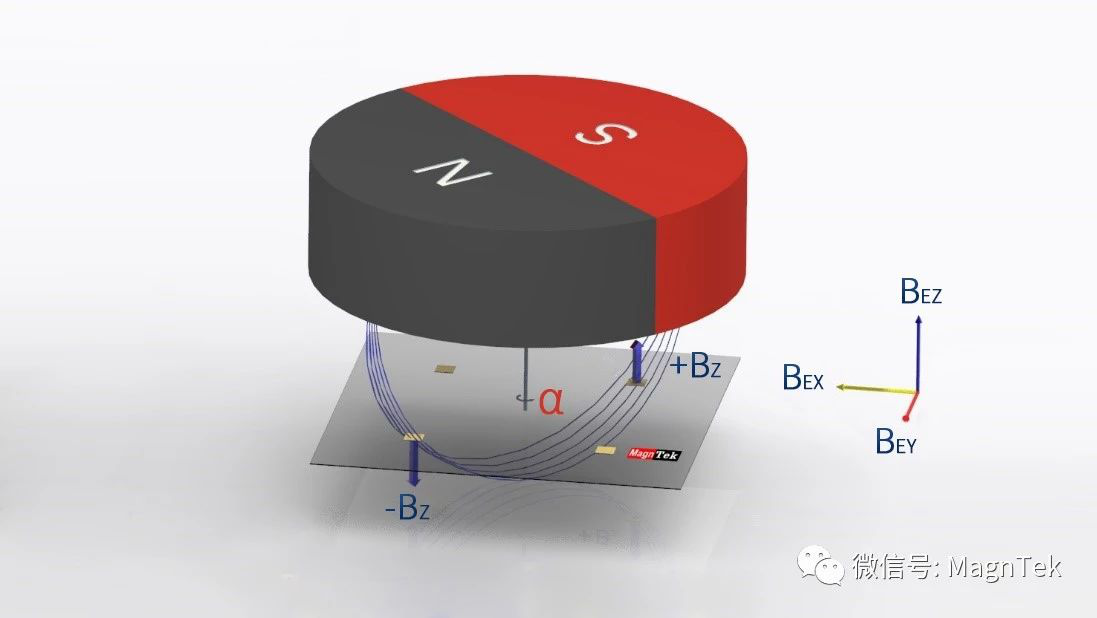
Fig. 1 Hall induction principle of differential leveling
01 | XY plane Angle detection
The horizontal hall plate only inducts the magnetic field component Bz which is perpendicular to the surface of the wafer. The two hall plates on the diagonal each other form a set of difference pairs. The magnetic field intensity induced is Bz-(-Bz)=2Bz. This results in two pairs of differential Hall Bridges at 90° each other. With 1 above the chip of radial magnetization magnet rotating, second to put each other into 90 ° difference hall bridge produced cosine theta and sine theta voltage signal as shown in the figure below, because the hole plate of sensitivity is lower, the voltage is usually only a few here, mV by subsequent amplification, calibration and operation of a signal processing circuit, can be to solve the Angle theta. The Angle information θ of MT6701 is output to the user in the form of ABZ, PWM, analog line voltage and the absolute value of a 14-bit binary digit word.
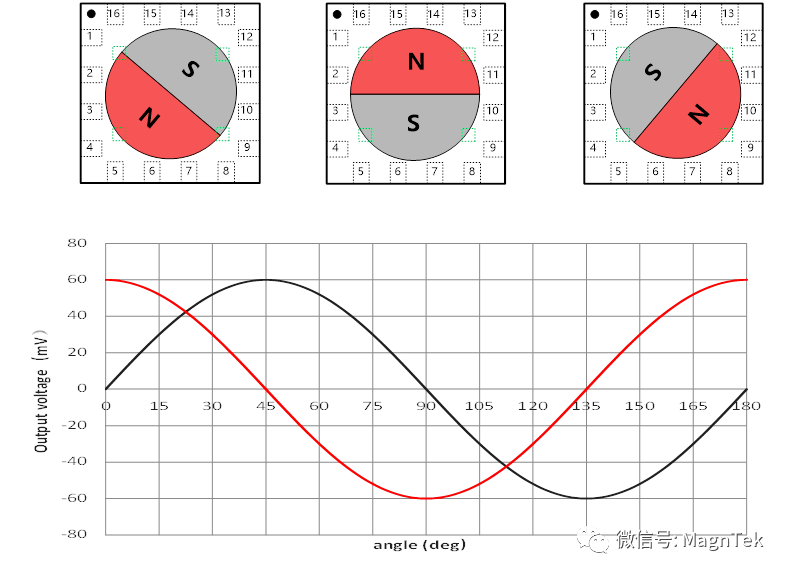
Fig. 2 Hall Angle Induction Principle of Differential Leveling
02 | difference hole plate of each direction of the magnetic field interference
Because of the Hall disk array on the chip, only the magnetic field perpendicular to the surface of the chip is induced. As shown in Figure 1, when a radially magnetized magnet with a pair of poles is installed directly above the wafer, the magnetic force lines from the North Pole of the magnet to the South Pole of the magnet just make the wafer into a pair of Hall Disk placed at 180°. One inducts the magnetic field of + Bz, while the other inducts the magnetic field of -Bz. The total induced magnetic field is 2Bz after difference operation. At this time, if there is interfering magnetic field BEX in the X direction or interfering magnetic field BEY in the Y direction, the Hall disc will not produce any induction to it. If there is a interference magnetic field Bez in the direction of Z, then one hall plate can sense the magnetic field of Bez + Bz, and the other hall plate can sense the magnetic field of Bez-Bz. After difference calculation, the total induced magnetic field is still 2Bz. Therefore, the differential hall plate design can perfectly eliminate the interference of the external magnetic field in any direction. This has a natural advantage in many applications.
03 | vertical direction (Z direction) pressure detection
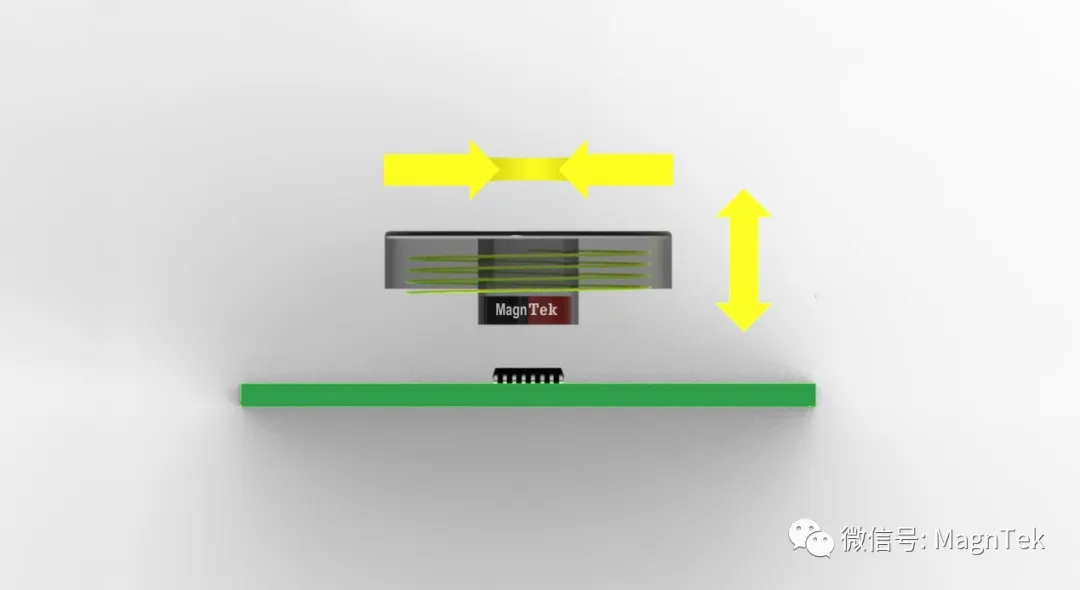
In addition to the angular rotation detection in the XY plane, the MT6701 also integrates the vertical (Z) direction compression detection function.
This function uses the voltage signals of Cosθ and Sinθ generated by two pairs of 90° Bridges, whose square sum A represents the absolute strength of the magnetic field sensed by the Hall disc:
A = ASin2 theta + ACos2 theta
When the distance between the wafer and the magnet is fixed, no matter what the Angle θ is, the calculated value of A is fixed. However, when the direct distance between the magnet and the wafer changes, the magnetic field induced by the hall plate changes accordingly, so does A. It is the use of this mathematical relationship, MT6701 to achieve the Z axis press function, press the threshold can be programmed through the chip built-in EEPROM, in order to facilitate the design of various applications.
| convenient and anti-interference ability of the design – the SSI interface
MT6701 provides a convenient and anti-jamming SSI digital transmission interface.
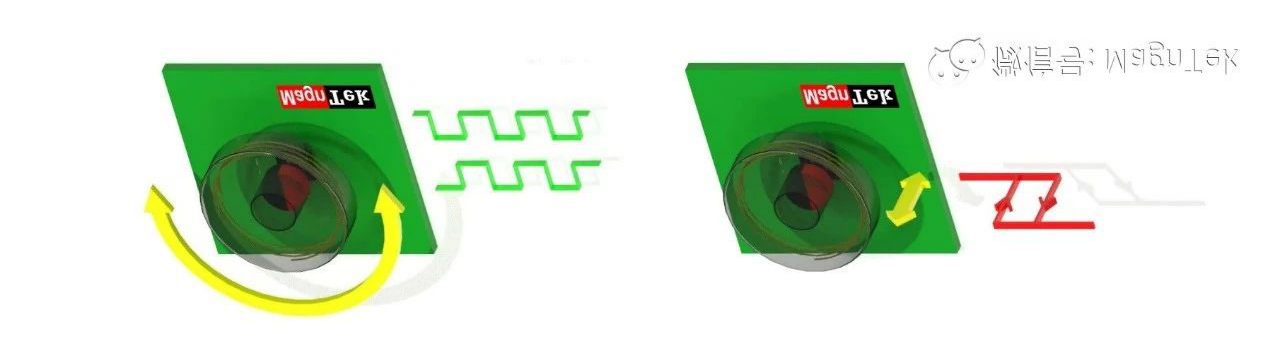
Figure 3 SSI communication interface of MT6701
MT6701 provides a convenient SSI interface. Compared with the I²C or SPI interface, the SSI interface does not require communication commands. The host computer only needs to provide the chip selection signal and clock to read data from the chip. MT6701 provides 24 bits of fixed format data per frame on the SSI interface, including 14 bits of absolute Angle data, 4 bits of magnetic field state information (including weak magnetic field, strong magnetic field, press, velocity saturation), and up to 6 bits of CRC data check bits.
The 6bit CRC data check bit greatly improves the anti-interference ability of data transmission. In many applications, the encoder is close to the motor body or power line, and the electromagnetic environment is harsh, so the signal transmission is easily disturbed. The upper computer can greatly reduce the probability of receiving wrong data by 6bit check bit judgment.
The typical application of | MT6701
01 | brushless dc servo
Brushless DC steering gear is a high-end series of steering gear, widely used in UAV, gimlet, robot joint control and other scenarios.
The general form of brushless DC actuator is hollow cup motor. Due to space limitation, the encoder is usually placed on the side of the motor, and the general magnetic encoder will be affected by the magnetic field of the motor. Only the differential Hall type magnetic encoder can easily and perfectly eliminate this interference.
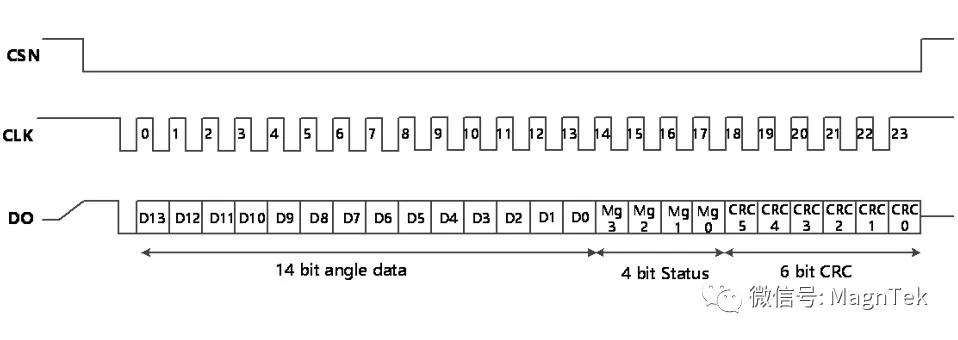
Fig. 4 Magnetic field in steering gear
02 | based on magnetic “knob and button” application
Current knob, it is to use traditional potentiometer to achieve basically, the price is cheap, application is mature. However, with the pursuit of more beautiful, more convenient and more reliable smart home appliances, the need to replace the traditional potentiometer with magnetic Angle encoder chip has emerged.
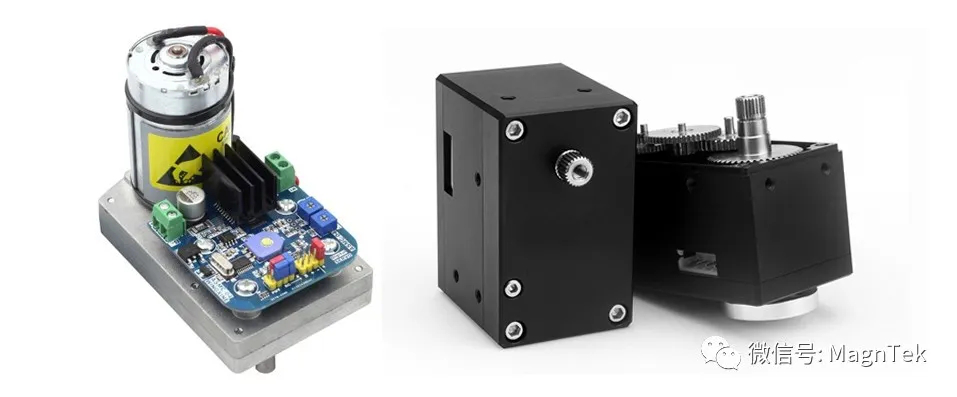
Figure 5. Traditional potentiometer knob magnetic Angle encoder switch
Using a magnetic Angle encoder to encode a chip as a knob has two advantages
Non-contact work, the service life is much higher than the potentiometer. For the equipment running all the time, the general potentiometer tens of thousands of times of limited service life will appear to be limited, and the service life of magnetic Angle encoder has nothing to do with the number of times, the general service life is more than 10 years.
2 is also because of the non-contact work, the magnet and the chip can be separated, so it can easily achieve waterproof design, such as PCB board and knob (containing magnets) with glass and other materials are completely isolated, both waterproof and completely does not affect the use.
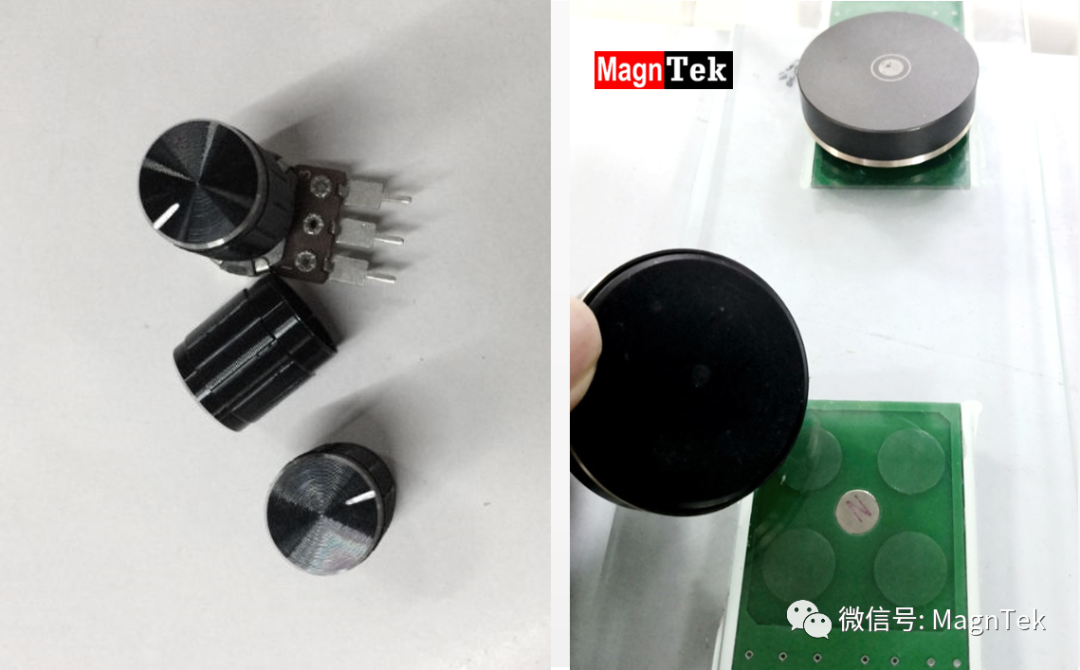
Fig. 6MT6701 realizes the “Knob + Press” function